The Missing Heart of Tutankhamun: Unravelling a Modern Mummification Myth
One claim regarding Tutankhamun continues to dominate the literature and the media: that his mummification was unusual because his heart was absent. The implication is that the heart was essential to remain in the body, and that its absence suggests Tutankhamun died far from home. The theory intrigued me enough to investigate its origins during my dissertation research. I found that the notion of retaining the heart during embalming originates from Grafton Elliot Smith’s early twentieth-century observations of heart preservation in some mummies from the Twenty-first Dynasty. More recently, Wade and Nelson’s study challenged thisassumption, showing that the heart was frequently absent and that heart amulets did not consistently accompany or symbolically replace it (Wade and Nelson, 2013: 4202). My own analysis of 33 anthropogenically mummified subjects yielded similar results. Heart retention was confirmed in only 21%, while 9% showed partial retention. In 28% the presence or absence of the heart was indeterminate due to obstructive packing material. Strikingly, 42% exhibited no heart retention at all (Aziz, 2023: 37). Crucially, there is a lack of textual evidence from ancient Egypt indicating that heart retention was a ritual necessity. Instead, the belief appears to be a modern construct, shaped by four key sources.
Diodorus Siculus (c. 90-30 BCE)
The Greek historian claimed embalmers removed all organs except the kidneys and the heart. Yet he offered no rationale, and modern imaging has shown his account to be anatomically inaccurate.
Grafton Elliot Smith (1906)
Smith’s anatomical studies led him to generalise Diodorus’s claim across all dynasties. He wrote:
In all cases the heart is left in the thorax attached to the great blood vessels… This striking confirmation of the statement of Diodorus has not, so far as I am aware, been recognised hitherto.Larger-scale studies have since disproven this generalisation.
The Book of the Dead
Spell 30B, which implores the heart not to speak against the deceased, has been interpreted by some scholars as evidence that the heart needed to remain in the body for successful passage to the afterlife. Yet this is a symbolic reading, not a surgical prescription.
Walker’s classification of ib and haty
Walker distinguishes between ib, the psyche, and haty, the anatomical heart, but acknowledges their interchangeable use in Egyptian texts. Both terms appear in the Ebers Papyrus (c. 1550 BCE) in contexts that blur anatomical and emotional meanings, reminding us that even today the heart remains a metaphor for emotion and identity (Aziz, 2023: 16-19).
Conclusion
In short, the notion that the heart was ritually indispensable during mummification is a modern misconception.
I was honoured to present these findings at the XI World Congress on Mummy Studies, Cusco, in 2025. For an in-depth analysis, see my article “Vital Organs” in Nile Magazine, or my book The Human Brain in Ancient Egypt: A Medical and Historical Re-evaluation of Its Function and Importance.
References
Aziz, S. (2023) The Human Brain in Ancient Egypt: A Medical and Historical Re-evaluation of Its Function and Importance, Archaeopress, Oxford
Smith, G.E. (1906) A Contribution to the Study of Mummification in Egypt, with Special Reference to the Measures Adopted During the Time of the XXI Dynasty for Moulding the Form of the Body, Mémoires présentés à l’Institut Égyptien, t. V, fasc. I, Le Caire: Imprimerie nationale, pp. 1-53. Freely available at archive.org/details/b22288661
Wade, A.D. and Nelson, A.J. (2013) Evisceration and Excerebration in the Egyptian Mummification Tradition, Journal of Archaeological Science, 40(12): 4198-4206
Walker, J. (1993) Studies in Ancient Egyptian Anatomical Terminology, PhD thesis, School of History, Philosophy and Politics, Macquarie University, New South Wales
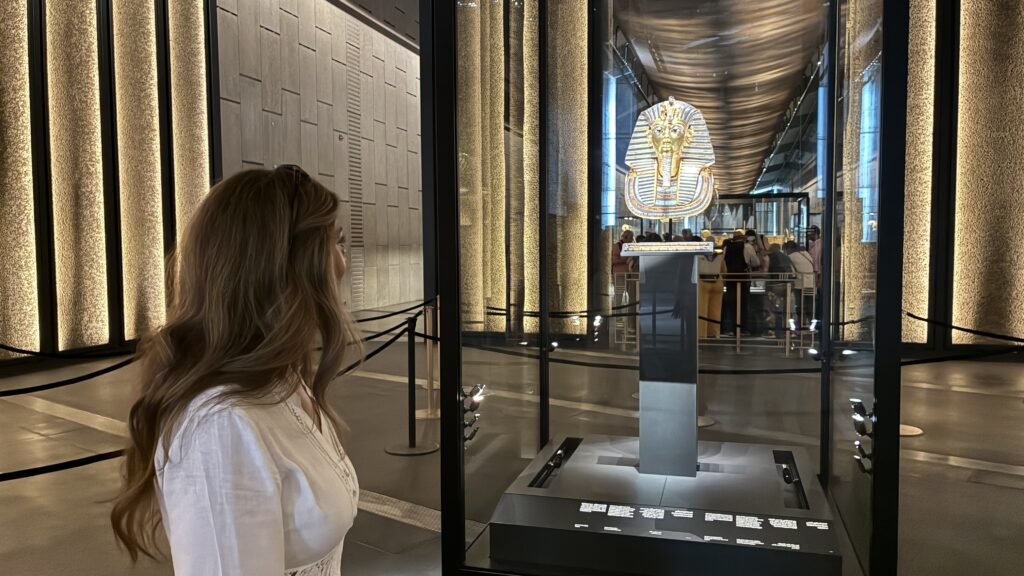
- Standing next to the magnificent golden mask of King Tutankhamun at the Grand Egyptian Museum, Cairo ↩︎